The Rivers, Reservoirs and Wells Behind Virginia’s Drinking Water
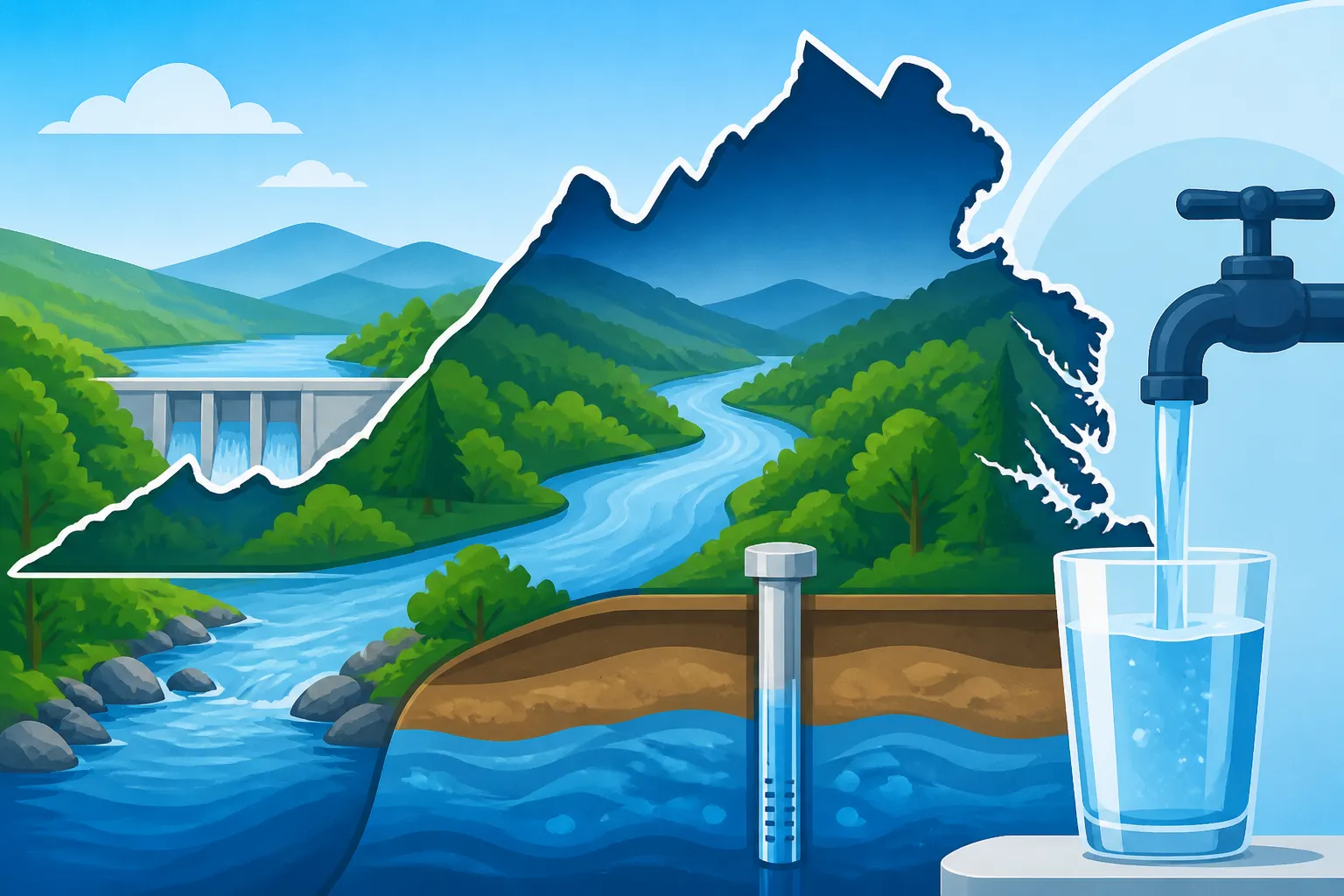
Virginia tap water does not come from one statewide source: a home may be supplied by a river, reservoir, groundwater well or a combination. That can make it hard to know what lies behind the faucet—or where to look for a reliable answer. Here’s how Virginia’s source waters fit into the path from watershed to tap, and how to identify the supply serving your address.
From source water to the faucet
A river, reservoir or well provides source water: water collected before it has been treated for drinking. It is not necessarily the water that comes out of a home’s tap. Before distribution, a public water system treats its supply and monitors it under applicable drinking-water requirements. The exact treatment and delivery arrangements depend on the system.
A useful way to picture the path is:
- Source: Water is drawn from a river, reservoir, well or combination of sources.
- Treatment: A waterworks processes the raw water to meet its needs and applicable requirements.
- Distribution: Treated water travels through the system’s pipes to homes, businesses and other customers.
- Household plumbing: The water passes through a building’s service line and indoor plumbing before reaching a faucet.
Each part answers a different question. A source name tells you where the raw supply originates, not by itself whether the water at a particular faucet has a problem. A treatment plant’s work tells you how the utility processes its supply, but not what condition an individual building’s plumbing is in. A water quality report describes results for the public system, but it may not tell you the exact water quality at every tap.
That distinction matters when you are looking into taste, odor, hardness, fluoride or lead. If water looks or tastes different, the cause could relate to the source, treatment, distribution system or plumbing inside a building. The source alone rarely settles the question. For help tracing who is responsible at different points, see Where Virginia Tap Water Comes From and Who Is Responsible for It.
Virginia’s supplies are not all alike. Some systems draw from surface water, such as rivers and reservoirs. Others use groundwater pumped from wells. Some use more than one source, either as part of their routine supply or to provide options for operating the system. A nearby river does not automatically supply every home in the surrounding area, and two homes in the same locality can be served by different systems.
The most reliable starting point is the water system serving the specific address. Once you know the utility or waterworks, you can look for its annual report, source-water information and customer notices. If you are unsure which system serves you, Looking Up Your Utility in Virginia’s Drinking Water Viewer explains one way to investigate.
Rivers and reservoirs: surface-water sources
Surface water comes from places such as rivers, streams and reservoirs. A utility may collect it directly from a river or use a reservoir that stores water before it is sent to a treatment plant. The collection point, the watershed feeding it and the utility’s operating arrangements all affect which source serves a particular system.
Surface water can change with conditions in the watershed. Rainfall and runoff may affect the amount and character of water flowing into a river or reservoir. Seasonal changes can also influence raw-water conditions. Utilities monitor and treat their supplies to address changing conditions, but the details vary by system. A source name is a starting point for understanding the supply, not a complete account of treatment or water quality.
Examples from Virginia show how varied these arrangements can be:
- Arlington County: According to Arlington County Government, the county’s water source is the Potomac River.
- Richmond: In the 2025 report, the City of Richmond Department of Public Utilities identified the James River as the water source it monitors throughout the year.
- Newport News Waterworks: In the 2025 report, the City of Newport News identifies surface water from Diascund Creek Reservoir, supplemented by the Chickahominy River, as the primary source of drinking water.
- Norfolk: In the 2026 report, the City of Norfolk Department of Utilities says its raw drinking-water sources were eight reservoirs, two rivers, and four deep wells.
These examples illustrate why it is risky to assume that a city draws from the closest river or from one source alone. A system may use a reservoir, a river, wells or a combination. The water supplied to a particular customer depends on the service system and its operations, not simply on the geography visible from a map.
Reservoirs are part of a supply system, not just a storage pond beside a treatment plant. Water entering a reservoir comes from its surrounding drainage area, which can include streams and runoff from the watershed. A river supply, in contrast, may be drawn from a particular intake location. In either case, source-water monitoring and treatment are important parts of turning raw water into drinking water.
There may also be differences between the source named in an annual report and the water a customer imagines reaching the home. A report can identify a primary source while also describing supplementary sources or a broader set of raw-water sources. It is worth reading the report’s description carefully rather than relying on a single label. For help finding reports, see Where Virginia Utilities Post the Annual Water Report Online and Consumer Confidence Reports in Virginia: A Homeowner’s Guide.
Groundwater and wells
Groundwater is water held below the ground in the spaces within soil and rock. Wells are used to draw that water to the surface. A public water system that relies on wells still has a treatment and monitoring responsibility; groundwater is not automatically ready to drink simply because it has passed through the ground.
Groundwater can have characteristics that differ from surface water. The geology and local conditions around a well can influence what is present in the water. Depending on the source and results, a utility may need to manage naturally occurring substances or other water-quality concerns. The system’s report and monitoring records are more useful for understanding its supply than assumptions based on a well’s depth or appearance.
Norfolk provides an example of a system that uses more than one kind of source. Its 2026 report describes raw water from reservoirs and rivers as well as deep wells. That mix demonstrates that surface water and groundwater are not always separate choices for an entire city; a waterworks may rely on both. The report’s source description does not mean every Norfolk customer can identify a particular source at the tap at a given moment. For that level of detail, customers can check the utility’s current information or contact the utility through its official website.
The Virginia Department of Health notes that fluoride may be found naturally in sources of drinking water, such as ground water. Natural occurrence is one reason a water report’s results should be read in context: a detected substance may have a natural source, may be added during treatment or may have another explanation. The source and the report help establish context, but they do not replace the reported measurement. See How to Find Out Whether Your Virginia Tap Water Is Fluoridated for how to investigate fluoride in a public supply.
Well water for a private home is a different situation from groundwater used by a regulated public water system. A private-well owner is generally responsible for arranging tests and deciding what follow-up is needed, while a public system monitors its supply under its own requirements. Do not treat a public utility’s report as a test of a nearby private well, or assume a nearby well draws the same water as the public system.
If a home is on a private well, the useful next step is a test matched to the source and the question—not a guess based on a neighbor’s results or the nearest water body. If a home is on public water, identify the waterworks first and use its report to learn about that system. The two situations call for different records and testing approaches.
Why a system may use more than one source
A water system’s supply can involve more than one source. Multiple sources may be part of how a utility manages its supply, but the exact reason and operating pattern are specific to the waterworks. A report may describe one source as primary and another as supplemental, or list several raw sources without explaining how each is used at all times.
Newport News Waterworks is one clear example: its 2025 report identifies Diascund Creek Reservoir supplemented by the Chickahominy River as the primary source of drinking water. The wording identifies a primary source and a supplement. It should not be expanded into an assumption about the exact proportion from each source, how that balance changes, or which source reaches a particular customer at a particular time unless the utility provides that information.
Norfolk’s report offers a different kind of description, listing reservoirs, rivers and deep wells among its raw drinking-water sources. That is a source inventory, not a promise that every source is used continuously or in equal amounts. When a report lists multiple sources, check how the utility explains the arrangement before drawing conclusions about what a household receives.
The term raw water also matters. It refers to source water before treatment. A report’s description of raw-water sources is not a statement that untreated river, reservoir or well water is delivered to customers. The utility’s treatment process stands between the raw source and distribution. Conversely, knowing that a system treats its water does not tell you every detail about how a source is blended or how it behaves at a particular building.
A system’s supply may also involve water purchased from another provider or treated at a facility serving more than one area. In that case, a customer may need to consult more than one report to understand the supply chain. The local utility can explain which system serves an address and whether another provider contributes water. Who Tests the Water When a Virginia Utility Buys It From Another? covers why that distinction can matter.
When reading a report, look for the labels used by the utility and keep them separate:
| Report wording | What it can tell you | What it does not establish by itself |
|---|---|---|
| Source water | The river, reservoir, well or other source identified by the system | The condition of water at every household faucet |
| Raw water | Water before treatment | That untreated water is delivered to customers |
| Primary source | A source the utility identifies as central to its supply | The exact share of water from that source |
| Supplemental source | An additional source described as supporting the supply | When, how often or in what amount it is used |
| Multiple raw sources | The system identifies more than one source | That all sources are used at once or in equal amounts |
| Finished or treated water | Water after the system’s treatment process | The condition of plumbing within a particular building |
If a report’s wording is unclear, the utility is the right place to ask what a source description means operationally. A source list is useful context, but it may not answer detailed questions about daily operations or the route of water to one neighborhood.
What treatment plants do—and what capacity means
A treatment plant is the point where a waterworks processes raw water before it enters the distribution system. Treatment is designed around the supply and the system’s needs. Processes can vary, so a plant’s name or source alone does not reveal the full treatment sequence. For an overview of how surface water can be treated, see From Reservoir to Faucet: How Virginia Surface Water Gets Treated.
The plant’s work is not the same as a household filter’s work. A utility treatment plant treats water for the public system under its operating and monitoring responsibilities. A household device, if one is used, treats water at a particular point in a building. Choosing a home filter without knowing the water concern can lead to an expensive mismatch. Start with the report and, if needed, a suitable test before deciding whether additional treatment is appropriate.
Capacity figures also need careful interpretation. The Northwest River Water Treatment Plant treats Up to 10 million gallons per day (MGD), according to Chesapeake Department of Public Utilities. This describes the plant’s treatment capacity, not the amount every household uses, the volume necessarily treated every day, or a measure of water quality by itself.
A plant’s capacity should not be confused with the size or quality of its source. A river or reservoir supplies raw water; a plant processes it; the distribution system delivers it. These are related parts of a supply chain, but they answer different questions. If you are trying to understand a water bill, for instance, a plant’s capacity is not a substitute for your account’s measured or estimated usage. If you are investigating a taste or odor, the capacity figure does not identify a cause.
There is also a difference between water quality information for the whole system and the water reaching an individual tap. Public reports summarize monitoring for the waterworks, while pipes and fixtures inside a building can influence water after it leaves the utility’s system. A clean system report is important information, but it does not test every household’s plumbing. If your concern is lead or another issue that can vary inside a building, consider whether a tap-specific test is needed. What a System-Wide CCR Does and Doesn’t Say About Your Own Faucet explains that boundary.
How to find the source serving your address
The quickest path is to identify the water system by address, then use that system’s own report and customer information. A county or city name alone may not be enough: service areas can cross local boundaries, and a locality may have more than one supply arrangement.
Use this process:
- Check a recent water bill or service account. The account usually identifies the utility responsible for billing or service.
- If you rent, ask the landlord or property manager. Water may be billed through the building rather than directly to the tenant. If you do not receive a bill, How Virginia Renters Without a Water Bill Can Find the Water Report offers a way to proceed.
- Confirm the waterworks serving the exact address. Use the utility’s official website or Virginia’s drinking-water records tools. Do not assume the nearest utility or water body is the correct one.
- Open the utility’s annual water quality report. Find the section describing source water, treatment and any purchased water.
- Check whether the report describes a primary source, supplemental source or multiple raw sources. Those terms are not interchangeable.
- Ask the utility if the report does not explain the supply arrangement. Use current contact details on the official utility website.
When you find a report, check that it covers the system you actually use and that you are reading the correct reporting period. A neighboring system’s report may cover a nearby street but not your home. Some providers may publish reports for multiple service areas or systems, so a company or locality name alone may not identify the right document.
Do not rely only on an online map of rivers, reservoirs or wells. Geographic proximity does not prove a service connection. A river may pass through a locality without being the source for every customer there, while a utility can draw from a source outside the immediate neighborhood. The report, service account and utility confirmation are better evidence.
If the report says water is purchased from or supplied by another system, follow that clue. The local provider may distribute water that was treated elsewhere, and the underlying source information may appear in a second report. Bought Water, Blended Water: When Your Supply Has Two Reports to Read explains how to handle that situation.
For a fuller understanding, pair the source description with the report’s water-quality results and the utility’s notices. A source tells you where water begins; treatment and monitoring information describe what happens before delivery. If your question is about an immediate change in appearance, taste, smell or pressure, contact the utility rather than trying to diagnose it from the source name alone. Odd Taste or Smell in Virginia Tap Water: A Troubleshooting Guide can help organize what to check.
What the source tells you—and what it cannot tell you
Knowing whether a system uses a river, reservoir or wells can help you understand the broad supply, but it is only one piece of the picture. It does not tell you the precise composition of water at a faucet, prove that a particular contaminant is present, or show whether a building’s plumbing is affecting the water.
For those questions, match the evidence to the concern:
- For general information about the public supply: Read the waterworks’ annual report and source description.
- For a recent system notice: Check the utility’s current notices and official communications.
- For a question about the utility’s operations: Ask the waterworks directly how it describes the source and supply arrangement.
- For a building-specific concern: Consider whether a tap sample or plumbing inspection is appropriate.
- For a private well: Arrange testing for the well itself; a public system’s report does not cover it.
- For health questions: Ask a local health department or medical professional rather than relying on a source label or a filter advertisement.
A report can also distinguish between a detected result and a limit or guideline. Those terms have specific meanings, and they should not be treated as interchangeable. If you are reviewing a result, check its units, sample point and context alongside the report’s explanation. Making Sense of MCL, MCLG, Units and Ranges in a Virginia CCR can help with the terminology.
Likewise, a statement about natural occurrence is not a measurement for every home. The Virginia Department of Health says fluoride may be found naturally in sources of drinking water, such as ground water. That explains one possible origin; it does not tell you whether fluoride occurs in a specific supply or at what level. For a particular system, consult its report or ask the utility where to find the relevant result.
If a source has changed or a utility uses more than one source, look for the utility’s explanation rather than assuming that a change means the water is unsafe. Source changes can affect how water is managed and may prompt customer questions about taste or other characteristics, but only system information and appropriate testing can answer a specific concern. A source name is context, not a substitute for a water-quality result.
The practical takeaway is to work from the address outward: identify the waterworks, confirm its source description, read the relevant report and then investigate the specific question you have. That approach avoids confusing a nearby river with your actual supply, a treatment-plant capacity with household consumption, or a system-wide report with a test of your own faucet.
Frequently Asked Questions
Does every Virginia home get water from a river or reservoir?
No. Virginia public systems may use surface water, groundwater or a combination. The source depends on the waterworks serving the address, so check the correct utility’s report rather than relying on the nearest water body.
Does a river or reservoir source mean the water is untreated?
No. A source-water description refers to where raw water comes from. Public water systems treat their supplies before distribution. Check the utility’s report for its treatment information.
Can a water report tell me exactly which source reached my tap?
Not always. A report may identify primary, supplemental or multiple raw sources without describing the precise mix delivered to an individual customer. Ask the utility if that distinction matters.
Is a public water report useful for a private well?
It can offer background on a nearby public system, but it does not test a private well. A well owner needs testing specific to that well.
Who should I ask about a water-quality concern?
For a public supply question, contact the utility serving the address. For health questions, ask a local health department or medical professional. For a private well, use an appropriate laboratory or qualified water professional.
Sources
- Arlington County Government — Water Service Line Inventory – Official Website of Arlington County Virginia Government (checked November 13, 2026)
- City of Norfolk Department of Utilities — Consumer-Confidence-Report-2026 (checked November 13, 2026)
- City of Newport News — Water-Quality-Report-Interactive-2025-ADA?bidId= (checked November 13, 2026)
- Chesapeake Department of Public Utilities — 2025-Water-Quality-Report (checked November 13, 2026)
- Virginia Department of Health — Drinking Water Home Page – Drinking Water (checked November 13, 2026)
Disclaimer
This article is for general informational purposes only and does not constitute professional advice. Laws, prices and regulations vary by location and change over time. Consult a qualified professional for guidance on your specific situation. Virginia Water Guide is not a government agency or water utility and is not affiliated with any public water system.