Where Virginia Tap Water Comes From and Who Is Responsible for It
Virginia tap water starts with a local source, but it may pass through several organizations before reaching a home. That can make it hard to know who supplies the water, who treats it, and whom to contact when something seems wrong. This article explains the path from source to faucet and how to identify the right organization for your question.
Where Virginia tap water begins
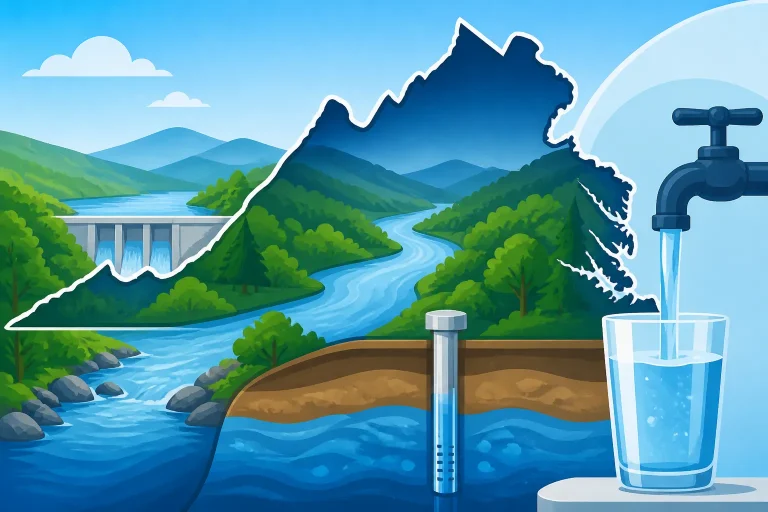
A home’s tap water begins with the source used by the water system serving that address. Depending on the system, the source may be surface water, such as a river or reservoir, groundwater from wells, or water purchased from another supplier. A county or city boundary alone does not tell you which source serves a particular home.
Even nearby homes can be connected to different systems. A utility may serve one neighborhood directly, while another neighborhood receives water through a different provider or service arrangement. A system may also use more than one source, or change which source contributes water over time. For those reasons, a broad description of water in a locality is a starting point, not a definitive answer for a particular address.
For a closer look at the kinds of sources used across the state, see The Rivers, Reservoirs and Wells Behind Virginia’s Drinking Water. To find the source for a specific address, start by identifying the water system that serves it. The utility’s annual water quality report, service-area information, or customer service staff may help establish whether the supply comes from surface water, groundwater, or another supplier.
Surface water and groundwater
Surface-water systems draw from rivers, reservoirs, lakes, or other surface sources. The water must be treated before it is distributed for household use. The treatment process is designed around the characteristics of the source and the treatment goals for that system. Source conditions can change, so treatment facilities may use several processes and monitor how the system is performing.
Groundwater systems draw water from wells. Water from a well may have different characteristics from water taken from a river or reservoir, and the treatment needed can differ too. Some groundwater may receive treatment before distribution; the treatment approach depends on the system and the water. A well’s location or the fact that it is underground does not, by itself, tell a customer what treatment is used or what the finished water contains.
Some systems use a blend or purchase finished water from another system. In that situation, the organization that sends water to the local network may not be the same one that bills the customer or handles a household’s service request. Asking which waterworks serves an address, and whether it produces or purchases the water, can clear up that distinction.
Why source information is only part of the answer
Knowing the source is useful, but source alone does not establish the quality of water at a particular faucet. Treatment, storage, distribution pipes, building plumbing, and conditions inside a home can all affect what happens between the source and the glass. A report about the system is important context, but it cannot describe every pipe or fixture in every building.
If a report identifies a river or reservoir as the source, that does not mean untreated source water is what comes out of the tap. Public water systems treat water before delivery. If a report identifies wells, that does not mean the water has no treatment or that every well in the area has identical characteristics. The relevant questions are which system serves the address, what source it uses, what treatment it applies, and what testing information is available for that system.
A helpful starting sequence is:
- Identify the water provider for the exact address.
- Ask whether the provider draws from its own source, purchases water, or uses a combination.
- Find the provider’s water quality report and check which system or service area it covers.
- If the question concerns a particular faucet, consider whether building plumbing or a fixture could be relevant.
How water reaches the faucet
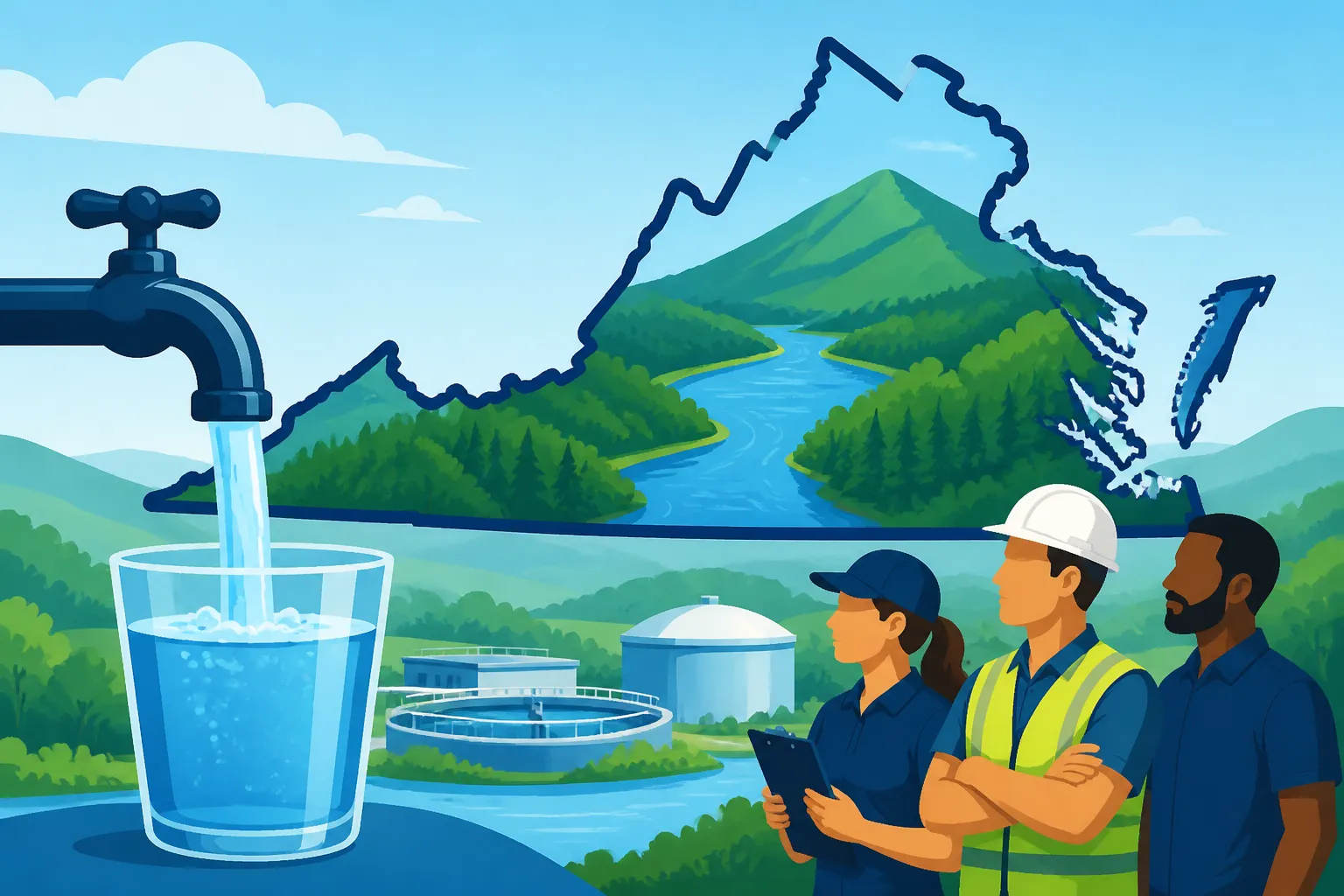
Tap water usually moves through a chain of activities rather than a single pipe from source to home. The details vary by system, but the broad path is source, treatment, storage or pumping where needed, distribution, and connection to a building. Different organizations can be responsible for different parts of that chain.
At the source, water is collected or pumped for treatment. A treatment plant then applies processes suited to the water and the system’s operating needs. After treatment, the system moves water through a distribution network. Storage tanks or other facilities may help the system maintain supply and pressure. From the network, a service connection carries water toward a building, where indoor plumbing delivers it to individual fixtures.
That overall path explains why “Who is responsible for my water?” can have more than one answer. One organization may own or operate a treatment plant. Another may own pipes in a neighboring area. A local utility may bill the customer and respond to service problems, while a wholesale supplier provides some or all of the water. The exact arrangement is local.
Treatment is system-specific
There is no single treatment recipe that applies to every Virginia water system. Treatment choices depend on the source, the water’s characteristics, and the system’s design. A utility’s report may describe treatment in general terms, but customers who want to understand a particular process can ask the provider what treatment is used for the system serving their address.
Treatment at a plant is also different from treatment inside a home. A system may deliver water that meets applicable requirements while a household still has a concern tied to its plumbing, a faucet, an appliance, or a taste preference. Conversely, a filter installed at home is not a substitute for understanding an official advisory or following directions from the utility.
For questions about added fluoride, use the report or ask the system directly rather than assuming that all providers make the same choice. Which Virginia Community Waterworks Add Fluoride? Each One Decides for Itself explains why this is a system-specific question.
Distribution and building plumbing
Once water leaves a treatment facility, it has to travel to customers. Pipes and other facilities make up the distribution network, and responsibility for that network may vary by location. A utility can help explain where its responsibility ends and where a customer’s plumbing begins. That boundary matters when a problem appears at one building but not elsewhere.
Water can also behave differently inside a building than it does in the public network. Materials in household plumbing, how long water has remained in pipes, and the condition of fixtures can affect what comes from a particular tap. A system-wide report does not inspect or test each home’s indoor plumbing. If the concern is about a specific faucet, the water system’s test results may not answer every question about that location.
When water looks, smells, or tastes different, first note whether the change affects one tap or several, whether it involves hot or cold water, and whether neighbors report the same issue. That information can help distinguish a possible household plumbing issue from a broader service concern. It does not diagnose the cause, but it gives the utility useful details when you contact it.
Who does what: utilities, suppliers, and regulators
The organization shown on a water bill is often the first place to begin, but the biller is not always the only organization involved in delivering water. Virginia systems can have different ownership and operating arrangements. A city, county, authority, or private company may operate a water system, and a local provider may also buy water from another supplier.
The organization that directly serves a customer is generally the best first contact for questions about the address, account, service interruptions, local notices, and the system’s water quality report. If it purchases water, it can explain which supplier provides that water and which report applies. If the customer needs information about a specific facility or source, the local provider can clarify whether another organization has that information.
For a comparison of common arrangements, see Is Your Virginia Water Run by a City, an Authority or a Company?. The name on a bill, a water tower, or a report can be different from the name a customer expects, so match the system to the address rather than relying on a familiar locality name.
| Question | Best place to start | Why |
|---|---|---|
| Which water system serves this address? | The utility or water provider shown on the bill or service records | It can confirm the service area and the relevant system |
| Does the system use its own source or buy water? | The local provider | A customer-facing provider can explain its supply arrangement |
| Where is the current water quality report? | The provider’s official website or customer service | Reports are system-specific and may be posted under a system name |
| Is there a current service notice? | The provider’s official notice channels | Local notices apply to defined systems or areas |
| Is the question about a state drinking-water requirement? | Virginia Department of Health’s Office of Drinking Water information | The state office oversees drinking-water requirements |
| Is the issue limited to one fixture or building? | The provider first, then an appropriate plumbing or water-testing professional if needed | A system-wide result may not explain conditions inside a home |
The role of Virginia’s drinking-water oversight
The Virginia Department of Health’s Office of Drinking Water has primary authority in the Commonwealth of Virginia to oversee Safe Drinking Water Act requirements. That role is different from operating every local water system. The Office of Drinking Water provides state-level oversight; the provider serving an address operates or arranges the water service and is usually the practical first contact for local questions.
The Virginia Department of Health says state governments, including Virginia, are approved to implement these rules and drinking water standards for EPA through the Waterworks Regulations. This describes Virginia’s role in implementing drinking-water requirements. It does not mean a customer should contact the state office first for every billing, plumbing, or service question.
For a broader explanation of oversight and system responsibilities, read How Public Drinking Water Is Regulated in Virginia. A customer who is unsure whether a question belongs with the provider or a regulator can begin with the provider and ask which organization handles that issue. If the concern involves an official notice or a possible compliance matter, the provider’s report and notice information can help identify the relevant system and contact route.
Responsibility can be divided
Responsibility is not always a single handoff. A water supplier may produce treated water, while another utility distributes it. A local provider may manage customer accounts but rely on an outside supplier for water. A building owner may be responsible for indoor plumbing, while the utility operates the public distribution network. The boundaries depend on the arrangement and the location.
For a customer, this means it is useful to separate the type of problem before deciding whom to contact:
- Account or billing question: start with the organization that bills the account.
- Pressure, interruption, or local service concern: contact the provider serving the address.
- Water-quality report or system notice: contact that provider and identify the system named in the report.
- Problem at one fixture: notify the provider if appropriate, while recognizing that building plumbing may also need attention.
- Question about state drinking-water oversight: consult information from the Virginia Department of Health’s Office of Drinking Water.
How to identify the system for your address
A locality name does not always identify the waterworks serving a home. The provider’s service area may cross municipal boundaries, and one locality may include more than one system. A rental home, condominium, or business may also receive water through a building arrangement that is not obvious from the address alone.
Start with a recent water bill if one is available. Check the provider name and any system or service-area details. If a landlord, property manager, homeowners association, or billing service handles the account, ask which water system supplies the building and request the name of the underlying provider. If the household has no bill in its name, How Virginia Renters Without a Water Bill Can Find the Water Report offers practical ways to trace the relevant report.
Then compare that provider information with the name on the annual water quality report. A report may cover a system or service area rather than a single street. If a provider runs several systems, choosing the first report that appears in a search may lead to the wrong one. Confirm that the report’s system name and coverage match the address.
A practical lookup process
- Find the provider name. Look at the bill, service account, lease, closing documents, or building notices. If those do not identify it, ask the property owner or manager.
- Ask which waterworks serves the address. Use the exact street address and explain whether the building is a house, apartment, or shared property.
- Ask how the water is supplied. Find out whether the system uses its own source, purchases water, or combines supply arrangements.
- Locate the matching report. Check the provider’s official website or ask the provider where the report for that system is posted.
- Check the report’s scope. Confirm that it covers the correct system, service area, and reporting period. If the provider operates multiple systems, ask which one applies.
- Save the system name and contact details. This can make it easier to find notices and records later.
If the property is supplied by a private well rather than a community provider, the public-system report for a nearby utility may not describe that well. The property owner or manager can clarify the water source. For questions about health effects, contact the local health department or a medical professional. For questions about testing or treatment, the right next step depends on the source and the specific concern.
When the provider purchases water
A provider that purchases water may still be the customer’s main point of contact. It can explain which supplier provides the water and which report or reports are relevant. Depending on the arrangement, the local provider may distribute purchased water, handle accounts, and communicate with customers even though another organization treats the water.
This can lead to a common misunderstanding: a customer searches for the town or neighborhood name, finds a report from a nearby supplier, and assumes it applies. Instead, ask the local provider to identify the system and the relevant report. Who Tests the Water When a Virginia Utility Buys It From Another? addresses how testing responsibilities can work when supply is shared or purchased.
If the provider gives the name of a wholesale supplier, keep both names in your notes. One may be useful for local service and notices; the other may be relevant to treatment or source information. The provider can explain how those responsibilities are divided for the address.
Water quality reports and what they can tell you
An annual water quality report is a useful place to learn about a system’s source, treatment, monitoring, and reported results. It gives customers information about the public water system covered by that report. It is not a customized analysis of every home’s faucet, plumbing, or filter.
The report’s system name and scope matter as much as the results. If a utility serves multiple areas or purchases water, a report may not cover every location in the way a customer expects. Check the report’s introductory information and ask the provider if the address is included. When reading a result, pay attention to the contaminant name, units, reporting period, and explanation provided by the system.
For help understanding what a report can and cannot establish about a household tap, see What a System-Wide CCR Does and Doesn’t Say About Your Own Faucet. A system-wide report can be reassuring context, but it should not be treated as a substitute for a home-specific test when a particular home plumbing issue is the concern.
Read the report with a question in mind
It is easier to use a report if you first decide what you need to know. A source question is different from a question about a detected contaminant, a treatment method, or a taste complaint. Look for the relevant section rather than treating the report as a single all-purpose answer.
Useful questions include:
- Which water system does the report cover?
- Does it identify a source or a purchased supply?
- What treatment information does it provide?
- Which results relate to the customer’s concern?
- Does the report explain a term or unit that is unfamiliar?
- Does it identify a contact point for follow-up questions?
Reports are also records of a system, not live alerts about every temporary event. If a customer needs current information about an interruption, advisory, or local issue, check the provider’s current notices as well as the annual report. Checking a Virginia Utility’s Notices and Drinking-Water Records explains how to look for both types of information.
What a report does not settle
A report cannot confirm the condition of every service connection or indoor pipe. It does not tell a customer whether a particular faucet filter is suitable for a specific contaminant unless that information is separately established. It also does not explain every change in taste, smell, color, or pressure. Those concerns may require a conversation with the provider, a home plumbing assessment, or a test selected for the question.
A report is not a promise that no water-quality concern could ever arise. It is one important record of the system’s monitoring and results. If a report includes a notice or an unfamiliar result, read the explanation and contact the provider for clarification. Do not infer health effects from a number alone; for health questions, ask the local health department or a medical professional.
What to do when something seems wrong
When tap water changes in appearance, taste, smell, or pressure, try to determine whether the issue appears to affect the whole home, a single fixture, or multiple nearby properties. The pattern is useful information, though it does not prove the cause.
If water changes throughout the home or neighbors notice the same thing, contact the provider serving the address. Ask whether there is a service notice or ongoing work and whether the provider has guidance for customers. Use the provider’s official website to find current contact details and notices. Do not rely on an old message or a report from a neighboring system as confirmation of current conditions.
If the change is isolated to one faucet, compare it with another cold-water tap and note whether the problem occurs with hot water, cold water, or both. A faucet aerator, appliance connection, or indoor plumbing issue may be relevant. The provider can help establish whether its service is affected, but a building-specific issue may require help from a qualified plumbing professional.
For unusual taste, odor, or color
A change in taste or odor can be noticeable without identifying a particular contaminant. It is best not to diagnose the cause by smell alone or buy a treatment device before understanding what needs to be addressed. Contact the provider first and describe what changed, when it began, and where it appears. Odd Taste or Smell in Virginia Tap Water: A Troubleshooting Guide offers a structured way to narrow down possible sources of a change.
If the provider says the system is operating normally but the issue continues at one home, ask whether a home-specific test or plumbing check may be appropriate. A filter should be selected based on a defined need and its certification claims, not a broad promise to improve water. Check that the device is certified for the specific reduction claim and that the claim matches the test results or concern.
For notices and advisories
A system notice is more immediate than an annual report. Follow the instructions from the provider or the relevant public authority, and confirm that the notice applies to the address. If the notice concerns a use restriction or water safety precaution, do not assume that a filter or household treatment device replaces the stated directions.
Use the provider’s official channels to check whether the notice has changed or ended. A post shared by someone in a nearby community may refer to a different system. For a notice that instructs households to boil water, follow the applicable directions and consult When the Utility Says Boil: A Virginia Household’s Guide to Advisories.
For pressure loss or interruption
A pressure problem can be related to work or conditions in the public network, but it may also be limited to a building or plumbing fixture. Contact the provider if the change affects more than one tap, continues, or appears to affect nearby properties. Describe when it began and whether other parts of the home are affected. If the concern is limited to one fixture, the provider may still help determine whether the public service is involved.
Avoid assuming that a temporary change has a single cause. The provider can explain whether it knows of work or a system issue, and a qualified professional can assess private plumbing if needed. If the provider issues instructions, follow them and check for updates.
A simple way to keep the right information on hand
It is easier to solve a water question when the relevant system is already identified. Keep a note with the provider’s name, the system or service-area name, the location of its annual report, and the place where it posts current notices. If the home is rented, keep the property manager’s contact information alongside the provider details.
For a move, check the water provider before relying on a report from the former home or a nearby property. A report can be accurate for one system and still be irrelevant to the next address. Ask for the current provider, confirm the system name, and save the report that matches the new location.
If a household uses a filter or treatment device, keep its model and maintenance information with the water records. The device’s claims should match the water concern, and its upkeep should follow the manufacturer’s directions. A device does not change who operates the public system, and it should not be used to ignore a provider’s notice.
A practical record should make it easy to answer these questions:
- Who provides water to the address?
- What system name appears on the relevant report?
- Is the water produced by that provider or purchased from another supplier?
- Where are current notices posted?
- Who should be contacted about a public service problem?
- Is the concern about the public system, building plumbing, or a particular fixture?
Keeping those basics together does not require a detailed technical file. It simply helps a household reach the right organization sooner and avoid confusing one system’s information with another’s.
Frequently Asked Questions
Does every Virginia home get water from a city utility?
No. The provider and arrangement depend on the address. Water service may involve a city, county, authority, company, or supplier relationship. Check with the provider serving the exact property.
Can I use a nearby water quality report if I cannot find my utility’s report?
Do not assume it applies. Reports cover particular systems or service areas. Ask the provider to identify the correct report for the address.
Who should I contact first about a change in tap water?
Start with the provider serving the address, especially if the change affects several taps or may affect neighbors. If it is limited to one fixture, household plumbing may also be involved.
Does a system-wide report tell me exactly what is at my kitchen faucet?
No. It describes the water system covered by the report, not every building’s plumbing or each individual faucet. A home-specific concern may call for additional investigation or testing.
Sources
- Virginia Department of Health — Information for Laboratories – Drinking Water (checked November 13, 2026)
- Virginia Department of Health — Information for Consumers – Drinking Water (checked November 13, 2026)
Disclaimer
This article is for general informational purposes only and does not constitute professional advice. Laws, prices and regulations vary by location and change over time. Consult a qualified professional for guidance on your specific situation. Virginia Water Guide is not a government agency or water utility and is not affiliated with any public water system.